Fat Quarter Size: Dimensions and Cutting Chart
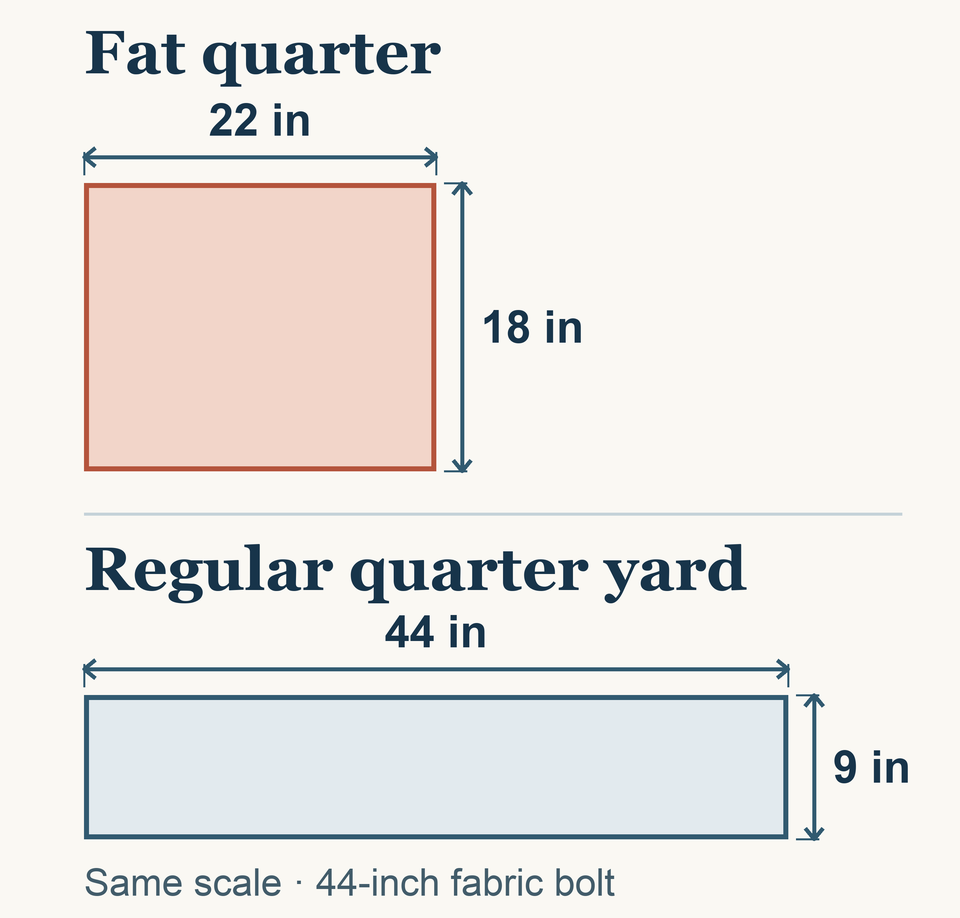
A US fat quarter of quilting cotton is typically 18 × 21–22 inches. It comes from splitting a half yard into two rectangles, each half as wide as the bolt. A regular quarter yard from the same bolt is a 9-inch strip across the full width. The fat quarter’s wider shape gives you room for pieces such as 10-inch squares.
Fat quarter vs. regular quarter yard
A half yard is 18 inches long. Split that piece midway between the two selvages, with the cut running parallel to them. Each fat quarter keeps the 18-inch length and half the bolt width. The table shows why 18 × 21 and 18 × 22 inches are both common. Fat Quarter Shop lists 18 × 21 inches, and Robert Kaufman gives 18 × 22 inches.
| Fabric cut | 42-inch bolt | 44-inch bolt |
|---|---|---|
| Fat quarter | 18 × 21 in. | 18 × 22 in. |
| Regular quarter yard | 9 × 42 in. | 9 × 44 in. |
The two cuts have equal area when they come from the same bolt and are measured before trimming. On a 44-inch bolt, both shapes below cover 396 square inches. For a single 2½ × 40-inch strip, choose a regular quarter yard with at least 2½ inches of usable depth and 40 inches of usable width. Check that the print runs the way you want.
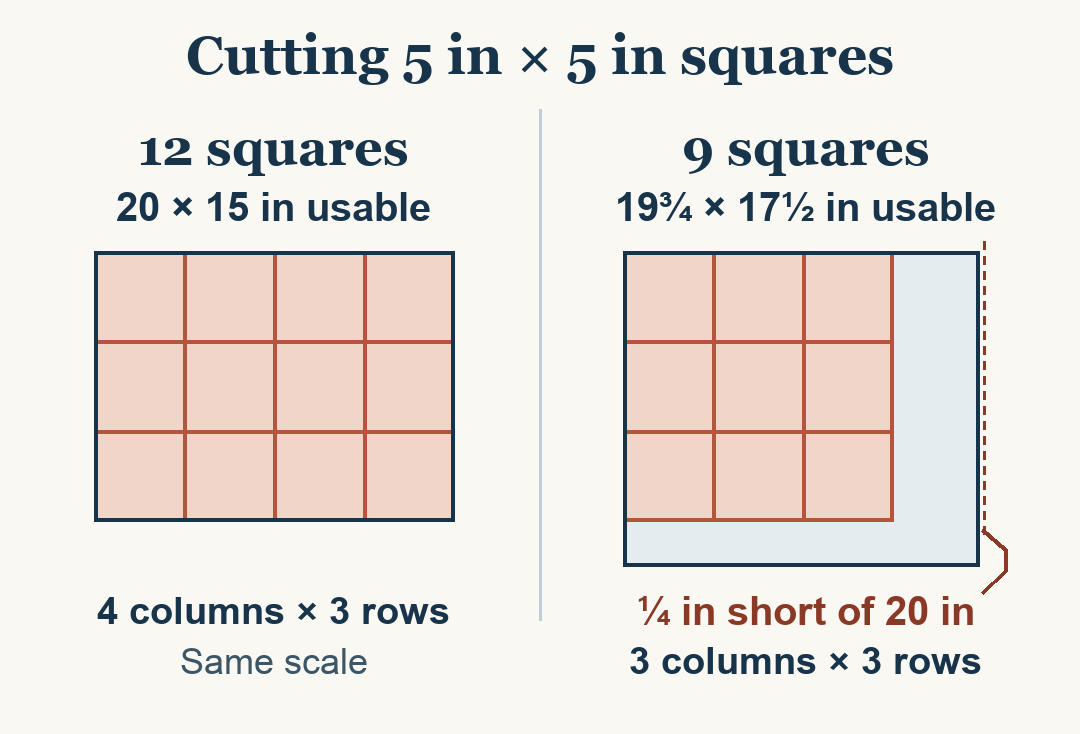
How many squares can you cut from a fat quarter?
You can cut twelve 5-inch squares in a 3 × 4 grid from at least 15 × 20 inches of usable fabric. In the 17½ × 19¾-inch example below, the long edge is ¼ inch short of 20 inches. Only three squares fit along that edge, leaving nine 5-inch squares in a 3 × 3 grid.
| Square side | 18 × 21 in.Nominal | 18 × 22 in.Nominal | 17½ × 19¾ in.Usable example |
|---|---|---|---|
| 2½ in. | 56 | 56 | 49 |
| 4½ in. | 16 | 16 | 12 |
| 5 in. | 12 | 12 | 9 |
| 5½ in. | 9 | 12 | 9 |
| 6½ in. | 6 | 6 | 6 |
| 8½ in. | 4 | 4 | 4 |
| 10 in. | 2 | 2 | 1 |
To check a different cut size, divide each usable side by the square size, round each result down to a whole number, then multiply. A 5½-inch square fits three times along 18 inches and four times along 22 inches. The same square fits only three times along a 21-inch edge, so the yield drops from 12 to 9. Sewing.org’s precut guide also lists 12 five-inch squares from a nominal 18 × 22-inch fat quarter.
How to measure usable fabric before cutting
- Lay the fabric flat. Measure after any washing your project calls for and after pressing out folds. Keep the fabric relaxed while measuring.
- Find the rectangle you can actually cut. Measure inside the selvage and any frayed or uneven edges. Allow room to square up the fabric along the grain.
- Check the cutting list by fabric. Test the largest pieces and any direction-sensitive prints first. If a fabric has to supply both squares and strips, plan both shapes on one layout before cutting.
If the pattern lists finished block sizes as well, use its cutting instructions to find the actual size of each piece. When centering a motif in every square, check the print repeat before relying on the grid counts.
Example: planning for 42 five-inch squares
If your pattern needs 42 interchangeable 5-inch squares, four fat quarters that each yield 12 give you 48 squares. If each piece yields nine, four give you only 36, so you need five fat quarters to cut 45. If the pattern needs specific colors, do the same calculation for each color before buying. For example, two fat quarters that each yield nine can supply 18 blue squares, even when you have enough squares overall.
Before you buy or substitute fabric
Do four fat quarters make one yard?
Four fat quarters from the same bolt have the same nominal area as one yard. They come as four rectangles, so check whether your pattern needs an uninterrupted length for borders, binding, or backing. For a bundle, count how many pieces you have of each print and check which background or border fabrics the pattern lists separately.
How big is a fat quarter in centimeters?
A US fat quarter of 18 × 21–22 inches converts to about 45.7 × 53.3–55.9 cm. A metric fat quarter is cut from fabric sold by the meter. Tilda’s metric example measures 50 × 55 cm. If a pattern was written for one format and you buy the other, compare the dimensions with its largest cuts.
Planning the whole quilt? Use the quilt size guide to choose a finished size and the quilt backing calculator to estimate backing separately.